China has become a major sourcing destination for control automation equipment. Its suppliers offer PLCs, HMIs, servo drives, sensors, SCADA platforms, and industrial networking solutions. Global buyers now expect more than competitive prices. They need stable performance, clear documentation, responsive engineering, and dependable after-sales support.
Joseph Engelberger, widely recognized as a pioneer of industrial robotics, stated, “You can’t automate something that you can’t measure.” His observation remains practical today. A capable supplier should explain measurement accuracy, communication protocols, operating temperatures, and maintenance requirements. Buyers should also examine factory testing, product traceability, cybersecurity practices, and compatibility with existing systems. A polished website is not enough.
The leading Chinese control automation suppliers serve manufacturing, logistics, energy, packaging, water treatment, and process industries. Some provide complete automation projects. Others focus on specialized components or OEM integration. The difference matters. A supplier with strong hardware may still lack overseas commissioning experience. Another may offer excellent engineering but limited spare-part availability.
This guide reviews suppliers through a global buyer’s lens. It considers technical capability, production experience, certifications, customization, delivery consistency, and technical communication. It also recognizes an uncomfortable reality: supplier rankings are never permanent. Product quality can vary between series, and impressive claims may require verification. Request samples. Check references. Test response times.
Reliable control automation begins with evidence, not assumptions. The right partner should reduce downtime, simplify expansion, and support operators long after installation. That standard is demanding, but industrial systems leave little room for guesswork.
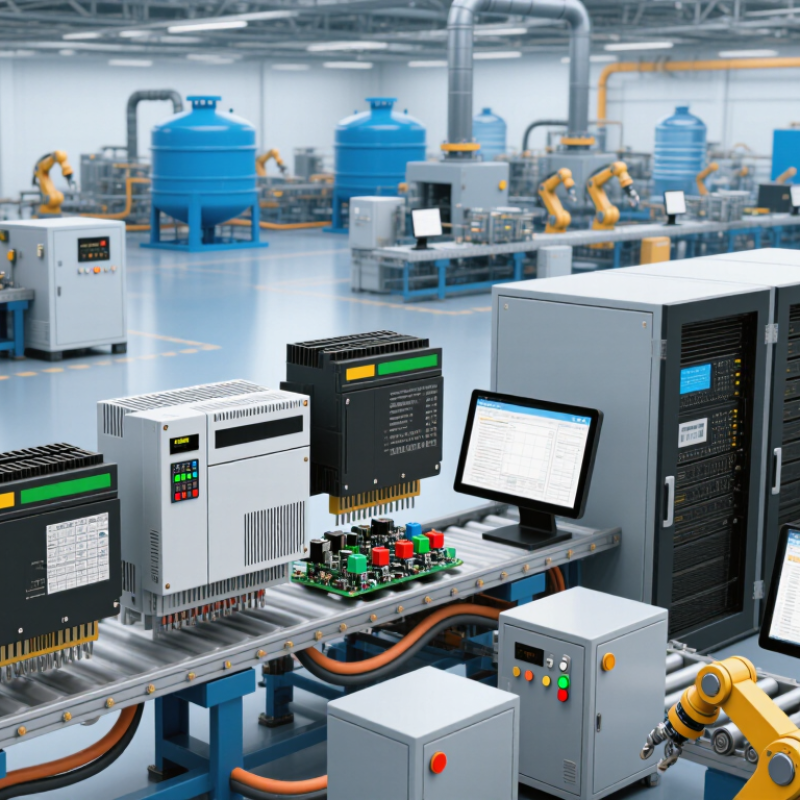
Control automation connects sensors, controllers, software, drives, and safety devices across an industrial process. A PLC manages fast machine logic, such as timing valves or stopping a conveyor. SCADA provides operator screens, alarms, trends, and remote visibility. A DCS coordinates continuous processes, where temperature, flow, and pressure must remain stable.
Drives control motor speed and torque, helping reduce mechanical stress and energy waste. Safety systems work separately from ordinary control functions. They can monitor emergency stops, guards, pressure limits, and hazardous movements. It is not magic. Poor wiring, unclear signals, or weak alarm design can still create dangerous confusion. Experienced suppliers should provide tested drawings, I/O lists, operating logic, and commissioning records.
Global buyers evaluating Chinese control automation suppliers should inspect engineering depth, not only quoted prices. Ask for factory testing, simulation methods, spare-part plans, and operator training details. Check whether the PLC, SCADA, DCS, drives, and safety layers communicate reliably under network failure. Documentation quality matters during maintenance, especially when technicians work across languages. Cybersecurity should include controlled access, backup procedures, and secure remote support. A practical review can still miss small field issues, such as reversed sensor polarity or an alarm set too tightly. That is why staged testing and site acceptance remain essential. Controls should be clear at three in the morning, not merely impressive during a sales demonstration.
| Automation System | Core Function | Typical Control Scope | Common Communication Technologies | Typical Industries | Relevant International Standards | Key Evaluation Criteria for Global Buyers |
|---|---|---|---|---|---|---|
| PLC (Programmable Logic Controller) |
Executes programmed logic, sequencing, timing, counting, motion and process-control tasks using industrial inputs and outputs. | Individual machines, production cells, packaging lines and discrete manufacturing systems. | Ethernet Modbus TCP PROFINET EtherNet/IP CANopen | Automotive, packaging, material handling, food processing, textile machinery and general manufacturing. | IEC 61131-2 for programmable controller equipment requirements; IEC 61131-3 for programming languages. | Program capacity, scan time, I/O expansion, motion capability, temperature range, cybersecurity functions, spare-part availability and engineering software support. |
| SCADA (Supervisory Control and Data Acquisition) |
Provides supervisory monitoring, data acquisition, alarms, historical trends, reports and operator visualization. | Multiple machines, remote assets, plant-wide monitoring and geographically distributed facilities. | OPC UA Modbus TCP/RTU MQTT IEC 60870-5-104 DNP3 | Water and wastewater, utilities, energy, infrastructure, manufacturing and building services. | IEC 62443 for industrial automation and control-system cybersecurity; OPC UA specifications for interoperable information exchange. | Redundant servers, alarm management, historian capacity, web-client support, role-based access, audit trails, data export and integration with PLCs and enterprise systems. |
| DCS (Distributed Control System) |
Coordinates continuous and batch-process control through distributed controllers, operator stations, engineering stations and centralized process management. | Large process plants with many control loops, regulated operating conditions and high availability requirements. | Foundation Fieldbus PROFIBUS HART OPC UA Industrial Ethernet | Oil and gas, chemicals, pharmaceuticals, power generation, cement, metals and other process industries. | IEC 61511 for safety instrumented systems in the process industry; IEC 62443 for control-system cybersecurity; IEC 61131-3 for controller programming principles. | Controller and network redundancy, control-loop performance, batch-management functions, alarm philosophy, lifecycle support, migration options and system integration capability. |
| Variable-Frequency Drive (VFD / AC Drive) |
Controls motor speed, torque, acceleration, deceleration and energy consumption by adjusting the frequency and voltage supplied to an AC motor. | Pumps, fans, conveyors, compressors, mixers, extruders and other motor-driven equipment. | Modbus RTU PROFINET EtherNet/IP CANopen Digital I/O | HVAC, water treatment, manufacturing, material handling, mining, agriculture and process plants. | IEC 61800 series for adjustable-speed electrical power drive systems; IEC 60204-1 for electrical equipment of machines. | Motor-control mode, overload rating, efficiency, harmonic mitigation, braking method, enclosure rating, EMC performance, safety functions and regional electrical compliance. |
| Safety Instrumented System (SIS) and Machine Safety |
Detects hazardous conditions and moves equipment or processes to a defined safe state through safety-rated logic, sensors and final elements. | Emergency shutdown, burner management, machine guarding, safe motion, interlocking and process-risk reduction. | Safety over EtherNet PROFIsafe CIP Safety Safety I/O Hardwired Circuits | Process plants, machinery, robotics, packaging, automotive, logistics, chemical production and energy facilities. | IEC 61508 for functional safety; IEC 61511 for process-industry SIS; ISO 13849-1 and IEC 62061 for machinery safety-related control systems. | Safety Integrity Level or Performance Level capability, diagnostic coverage, proof-test requirements, response time, certification documentation, fault tolerance and lifecycle management. |
| Industrial HMI (Human-Machine Interface) |
Displays process status and allows authorized operators to monitor equipment, acknowledge alarms and enter control commands. | Machine-level operation, cell control, local process stations and plant operator interfaces. | Ethernet OPC UA Modbus Serial Interfaces | Manufacturing, utilities, packaging, material handling, food and beverage and building automation. | IEC 60204-1 for machine electrical equipment; IEC 62443 principles for industrial cybersecurity. | Screen size, brightness, touch technology, ingress protection, operating-temperature range, recipe management, multilingual support and remote-access security. |
| Industrial Remote I/O | Collects field signals and controls actuators at locations separated from the main controller, reducing wiring and simplifying distributed installations. | Large machines, process skids, remote panels, water facilities and distributed production lines. | PROFINET EtherNet/IP Modbus TCP IO-Link PROFIBUS | Factory automation, water treatment, energy, infrastructure, process equipment and logistics systems. | IEC 61131-2 for programmable controller and associated equipment requirements; IEC 60529 for enclosure ingress-protection ratings. | Channel density, signal types, isolation, network redundancy, hot-swapping, diagnostic reporting, IP rating, hazardous-area suitability and wiring-terminal design. |