Why Choose a Hydraulic Cutting Machine?
A Hydraulic Cutting Machine can deliver steady force through thick or dense materials, where a clean cut and repeatable output matter. Its hydraulic system drives the blade with controlled pressure. Operators can adjust stroke, pressure, and cycle speed to suit different jobs. The result is practical, not magical: setup, blade condition, and material still shape every cut.
Manufacturing is also becoming more automated. The International Federation of Robotics reported 4,281,585 industrial robots operating in factories worldwide in 2023, a 10% increase from 2022 (World Robotics 2024). That figure does not measure hydraulic cutters directly. It does show why production teams increasingly value consistent, equipment-ready processes. In a busy shop, predictable cutting can help reduce rework and keep downstream stations supplied.
Force matters. So does fit.
Choosing a Hydraulic Cutting Machine means comparing the actual material, required tolerances, production volume, and available floor space. A machine suited to rubber sheets may not suit metal stock or layered composites. Hydraulic equipment can offer strong cutting force and stable operation, but it also requires routine inspection of hoses, seals, fluid, and guards. That maintenance detail is easy to underestimate. Buyers should confirm capacity and safety features against their real workload, not just a brochure’s maximum rating. The right choice is the one that performs reliably on the parts your team actually makes.
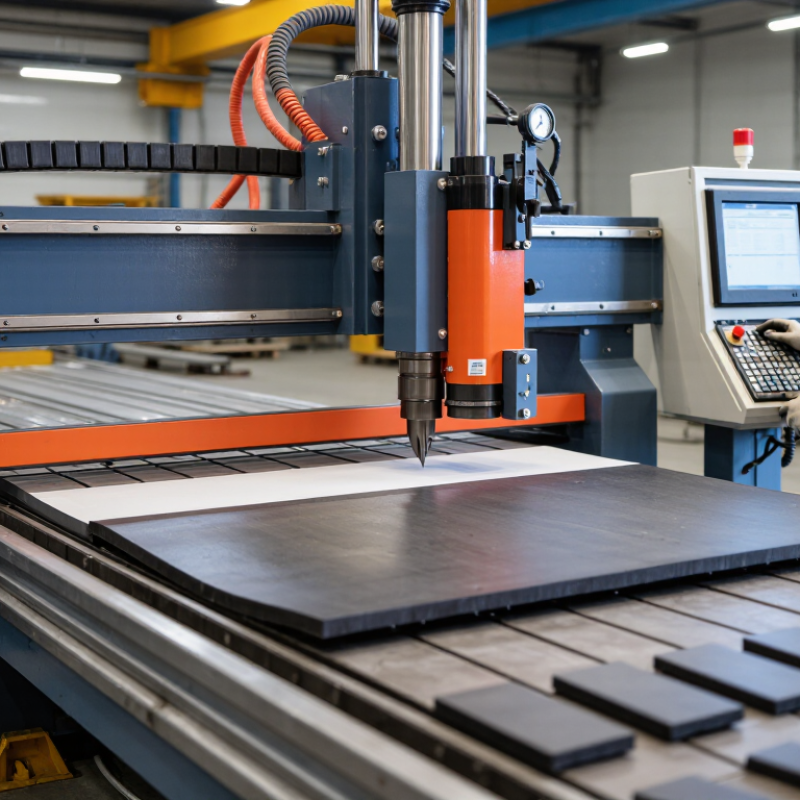
What a Hydraulic Cutting Machine Does: Pascal’s Law and Force Multiplication
Why Choose a Hydraulic Cutting Machine?
A hydraulic cutting machine turns controlled fluid pressure into a strong, steady cutting force. Its operation rests on Pascal’s law: pressure applied to a confined liquid spreads throughout the liquid. A pump sends oil into a cylinder, where pressure pushes a piston and drives the blade through material. The key is force multiplication. A small input piston can create substantial output force when the output piston has a larger area.
For example, at 10 MPa, a 10 cm² piston produces 10 kN of force; a 100 cm² piston produces 100 kN, before losses. That is the principle. Real machines lose some force through friction, leakage, and fluid heating, so rated pressure alone does not tell the whole story. Check cutting capacity, pressure settings, guarding, and maintenance requirements for the actual material and operating cycle.
Energy use matters, too. The U.S. Department of Energy’s 2006 Improving Pumping System Performance sourcebook estimates that pumping systems account for nearly 20% of global electricity demand. That figure covers pumping systems broadly, not cutting machines specifically, but it shows why pump efficiency deserves attention. A hydraulic cutter can deliver high force in a compact frame, though it is not automatically the most efficient choice. I would compare its real duty cycle with the job; that detail is easy to overlook.
How to Estimate Cutting Force: F = p × A (1 MPa = 1 N/mm²)
Why Choose a Hydraulic Cutting Machine?
A hydraulic cutting machine can deliver substantial force through a compact cylinder, making it useful for repeatable cuts in sheet materials. A basic estimate uses
F = p × A.
Here, p is hydraulic pressure and A is the effective piston area. Since 1 MPa equals 1 N/mm², multiplying pressure in MPa by area in mm² gives force in newtons.
For example, a cylinder with an effective area of 2,000 mm² operating at 10 MPa produces an ideal force of 20,000 N, or 20 kN. Check the cylinder’s effective area carefully; the rod reduces the working area on one side.
This estimate is useful, not perfect. Pressure losses, blade clearance, material thickness, and blade wear can all change the force available at the cut. A dull edge matters.
If estimating the force needed to shear material, use the material’s shear strength and the shear area, often cut length multiplied by material thickness. That is a different calculation from hydraulic pressure multiplied by piston area.
In practice, compare the estimated cutting force with the machine’s rated capacity, then allow a sensible margin. The numbers may look tidy on paper. Real cuts are less tidy.
Which Materials and Production Tasks Suit Hydraulic Cutting?
A hydraulic cutting machine is well suited to flat materials that can be cut cleanly with a matched die. Common choices include rubber sheet, gasket stock, foam, leather, textiles, and some flexible plastics. The right setup depends on material thickness, density, and how it responds to pressure. Foam, for example, can compress before the blade passes through. That matters. A sample cut can reveal a rough edge or a shape that springs back after cutting.
Typical production tasks include cutting repeated gasket shapes, foam inserts, leather components, and fabric blanks. A machine can also cut several layers at once, when the material and die allow it. This may save handling time, but stacked layers can shift or produce uneven edges. Not every job benefits from stacking. Hard, thick, or brittle materials may need a different cutting process, especially if the die cannot reach through them reliably. Before setting a production run, check the cut edge, dimensions, and material behavior on a small batch; the first result is useful, but it may not tell the whole story.
Why Choose a Hydraulic Cutting Machine? — Which Materials and Production Tasks Suit Hydraulic Cutting?
Typical suitability of common hydraulic cutting tasks
Hydraulic cutting is commonly used for blanking, punching, and shearing, as well as die cutting softer sheet materials such as rubber, plastics, leather, and textiles. Ratings are qualitative guidance, not standardized performance data; suitability depends on machine design, tooling, material, and thickness.
How to Compare Tonnage, Stroke, and Cycle Time
Why Choose a Hydraulic Cutting Machine? How to Compare Tonnage, Stroke, and Cycle Time
Compare tonnage, stroke, and cycle time as one working set. Tonnage is the maximum cutting force, but the required force changes with material, thickness, blade geometry, and cut length. A machine rated well above your calculated need may add cost without improving output. Check the rated force at the actual working position, then test your toughest regular material. Stroke sets the tool’s travel; too little can prevent a complete cut, while excess travel may slow the cycle. Cycle time should include approach, cutting, return, and loading—not just the cylinder’s downstroke. Small details matter.
The U.S. Department of Energy’s 2022 Industrial Decarbonization Roadmap estimates that industry accounts for roughly 30% of U.S. energy consumption. That broad figure is not a cutting-press benchmark, but it is a reminder to compare energy use alongside throughput. Ask suppliers for cycle-time data under stated material and operating conditions. Then run a timed trial with your own stock. One limitation: catalog figures rarely capture loading delays or warm-oil behavior.
Tips: Match force to your hardest routine cut, confirm the usable stroke, and record complete cycles per hour. Test real stock. Leave a safety margin, but avoid choosing tonnage by guesswork alone.
Which Safety Standard Applies to Press-Type Cutters: ISO 16092-3:2017
Why Choose a Hydraulic Cutting Machine?
Which Safety Standard Applies to Press-Type Cutters: ISO 16092-3:2017
ISO 16092-3:2017 sets safety requirements for hydraulic presses. It is a relevant reference when a cutting machine uses a press-type hydraulic action. But the label “hydraulic cutter” alone does not determine its scope. The machine’s design, operating mode, and intended material all matter. That distinction matters.
For a practical review, inspect the point of operation, the ram’s travel, and how the operator loads sheets. Check fixed or interlocked guards, two-hand controls, and presence-sensing devices where applicable. Also test emergency stops and verify that hydraulic pressure cannot cause unexpected movement during maintenance. Keep records of risk assessments, inspections, and changes to controls or tooling. These details are easy to overlook.
ISO 16092-3:2017 should guide the safety review, not replace it. A competent machinery-safety professional should confirm whether the machine falls within the standard’s scope and identify additional requirements for its configuration. A guard that works with one material size may leave a gap with another. That is worth checking twice.