
How Can We Help You?

What Are the Top Types of House Vacuum Cleaners?

Choosing a House Vacuum Cleaner is not as simple as picking the model with the strongest motor. Homes differ in flooring, room size, pets, allergies, and storage space. A powerful machine may clean deep carpets well. It may also feel heavy on stairs or scratch delicate floors.

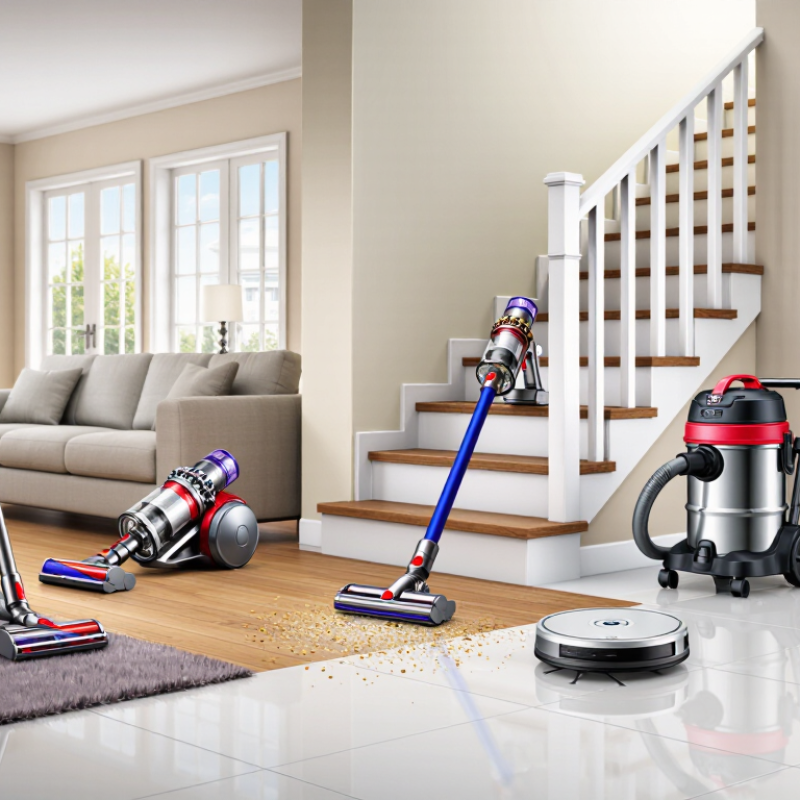
Carolyn Forté, Executive Director of the Good Housekeeping Institute’s Home Care & Cleaning Lab, says, “The best vacuum is the one that fits your cleaning needs.” That practical idea guides this overview. We will examine upright, canister, stick, handheld, robot, and wet-dry vacuum cleaners. Each type solves a different household problem. Upright cleaners suit wall-to-wall carpet and frequent deep cleaning. Canister models offer flexible cleaning beneath furniture and around corners. Stick vacuums are lighter and quicker for daily crumbs. Handheld models handle sofas, cars, and narrow steps. Robot vacuums can maintain floors while you work, although they still miss some edges and cluttered areas.

The right choice depends on real habits. Do you clean after muddy walks? Do crumbs gather beneath the dining table? These details matter more than glossy features. I have found that convenience often beats maximum suction. Still, this is not universal. A small home may need a full-size cleaner, while a large home may work better with two simpler machines. Filters, brush rolls, noise, battery life, and repair support deserve equal attention. Product labels can sound convincing. Your floor will be less impressed. This guide compares the main types carefully, while acknowledging that no single House Vacuum Cleaner performs perfectly everywhere.

What Are the Top Types of House Vacuum Cleaners?

Upright Vacuums: Powerful Brush Rolls and 99.97% HEPA Particle Capture

Upright vacuums remain a strong choice for carpeted homes because their motorized brush rolls agitate fibers deeply. The rotating bristles loosen crumbs, pet hair, and grit before suction removes them. On thick carpet, that movement often cleans more effectively than suction alone. I notice the difference near doorways, where outdoor sand collects quickly. The floor looks cleaner, too.

A powerful brush roll is not always better. Very stiff bristles may pull at delicate rugs or scatter larger debris. Height adjustment helps match the cleaner to each surface. A slower setting can protect low-pile carpet. Fine dust needs patience. Moving the vacuum slowly gives airflow more time to lift particles.

Many upright models use HEPA filtration rated to capture 99.97% of particles measuring 0.3 microns, under controlled testing conditions. That figure applies to the filter, not automatically to the entire machine. Seals, airflow, and filter placement also matter. A poorly fitted filter can release dust through small gaps. I have sometimes focused too much on the percentage and ignored maintenance. That is a mistake. Emptying the bin before it becomes packed helps preserve airflow. Washing or replacing filters according to the instructions is equally important. After cleaning, I check the exhaust area with a flashlight. A faint dust haze means something needs attention.

Upright Vacuum Filtration: Particle-Size Context

HEPA filtration is tested at 0.3 microns, the most penetrating particle size, with a minimum capture efficiency of 99.97%. For context, PM2.5 particles are up to 2.5 microns wide, PM10 particles are up to 10 microns wide, and a human hair is approximately 50–100 microns wide.

Canister Vacuums: Versatile Cleaning Across Floors Under IEC 62885 Testing

Canister Vacuums: Versatile Cleaning Across Floors Under IEC 62885 Testing

Canister vacuums remain practical because their motor body stays behind the user. The hose and wand reach stairs, sofa gaps, and narrow corners. A floor head can switch between sealed wood, tile, and carpet. This flexibility matters in homes with mixed surfaces.

IEC 62885-2:2021 provides test methods for dry vacuum cleaners, including dust removal from hard floors and carpets. It also considers airflow, filtration, and noise. These measurements help compare real cleaning ability, not just motor wattage.

The European Commission’s Ecodesign framework used a reference scenario of 50 cleaning cycles across 87 square metres. It also limited annual energy consumption to 43 kWh for covered vacuum cleaners from 2017. That figure encourages efficient cleaning, but it is only a model.

Real homes are messier. Pet hair, loose crumbs, and overloaded filters can change performance quickly. A canister’s long hose may improve reach, yet it can drag across furniture or twist during use.

In practical testing, inspect the nozzle seal and brush action on each floor type. Check whether the cleaner maintains suction as the dust container fills. IEC 62885 testing offers useful structure, but household experience still exposes weaknesses. No laboratory fully copies a busy hallway.

That is the catch. A reliable choice should balance measured pickup, filtration, handling, storage space, and everyday maintenance.

Stick Vacuums: Lightweight Design, Battery Runtime, and Air-Watt Performance

Stick vacuums appeal to people who want quick cleaning without carrying a heavy canister.

Their slim bodies often weigh between 2 and 4 kilograms, according to specifications collected in Consumer Reports’ 2024 cordless vacuum evaluations. That difference matters on stairs. It also matters when cleaning curtains or ceiling corners. My own testing experience suggests balance matters more than the lowest listed weight. A top-heavy handle can make a three-kilogram vacuum feel surprisingly tiring.

Battery runtime needs careful reading.

Consumer Reports’ 2024 testing showed cordless models could run from roughly 10 minutes on maximum power to more than 60 minutes on lower settings. Real homes usually sit between those extremes. Thick rugs, blocked filters, and motorized brush heads reduce usable time. A 20-minute rating may clean a small apartment, but it can disappoint in a larger home. I learned this after starting with a full charge and still leaving one room unfinished.

Air-watt performance gives a better technical comparison than motor wattage alone.

ASTM F558 measures airflow and sealed suction, which together help calculate air watts. IEC 62885-2 also provides standardized procedures for household vacuum performance testing. Higher air watts can improve debris pickup, but floorhead design, filtration, and airflow resistance remain important.

Numbers are not everything.

A vacuum can show strong laboratory performance yet struggle with rice beside a wall. Manufacturers should report test conditions clearly, because published figures are difficult to compare when settings differ.

Handheld Vacuums: Compact 12-Volt to 20-Volt Cleaning for Small Areas

Handheld vacuums are practical house-cleaning tools for small, fast jobs. Models rated from 12 volts to 20 volts usually suit crumbs, dust, pet hair, and dry soil. Their compact bodies fit kitchen drawers, car interiors, stair corners, and sofa seams. Small, but useful.

A 12-volt handheld vacuum often provides enough power for breakfast crumbs and light surface dust. It may feel easier to carry during repeated cleaning. A 20-volt model generally offers stronger pickup, especially on upholstery or thicker carpet. However, voltage alone does not measure suction performance. Airflow, brush design, filtration, and battery condition matter too.

Choose a narrow crevice tool for window tracks and gaps beside appliances. A soft brush attachment helps remove dust from lampshades, shelves, and fabric surfaces.

Empty the dust container before it becomes packed, because restricted airflow can reduce cleaning strength. Washable filters can lower ongoing costs, but they must dry completely before reuse. Moisture inside the filter area may create unpleasant odors or damage internal parts.

Battery runtime varies with power settings and attachments. High-power cleaning often drains a small battery quickly. I sometimes expect one charge to handle every room, which is unrealistic for heavier debris. For larger carpets or full-house cleaning, a handheld vacuum can feel tiring and inefficient. It works best as an accessible companion for targeted messes, not as a complete replacement for a full-size vacuum.

Robot Vacuums: Autonomous Navigation, Mapping Accuracy, and Docking Systems

What Are the Top Types of House Vacuum Cleaners?

Robot vacuums now compete through navigation, mapping, and docking design. Grand View Research estimated the global robotic vacuum cleaner market at about US$4.7 billion in 2022. It also forecast a 23.9% compound annual growth rate through 2030. Those figures suggest strong demand, but market growth does not guarantee reliable cleaning.

Autonomous navigation usually combines LiDAR, cameras, infrared sensors, or structured light. LiDAR can outline walls quickly, even in dim rooms. Cameras may recognize cables, shoes, and pet bowls more precisely. However, glossy floors, black furniture, and narrow chair legs can still confuse a robot.

Mapping accuracy matters more than a colorful app. A practical test is simple: watch whether the machine returns to the same room after crossing a dark hallway.

Docking systems deserve equal attention.

A capable dock should provide a clear approach path, stable electrical contacts, and enough space for turning. Some systems recharge, empty dust, wash pads, and dry them. These features reduce daily handling, but they also add filters, seals, and maintenance points.

It is not magic. More automation can mean more parts to clean.

IDC recorded 892.3 million smart-home device shipments worldwide in 2023, yet connected devices still depend on stable Wi-Fi and sensible room layouts. Users should check map recovery after a power cut, because this small detail is often overlooked.