7 Tips for Choosing a Marine Washing Machine?
Choosing a Marine Washing Machine is a small decision with major operational consequences.
On a vessel, every litre, kilowatt, and spare part matters.
A compact laundry room may serve dozens of crew members daily.
Salt air, vibration, limited freshwater, and irregular power loads create extra pressure.
The IMO Fourth Greenhouse Gas Study 2020 estimated that shipping produced 2.89% of global human-caused greenhouse gas emissions in 2018.
The report supports a practical lesson: onboard equipment should reduce waste wherever possible.
DNV’s Maritime Forecast to 2050 also highlights efficiency, electrification, and resilient vessel operations.
These findings make water consumption, cycle duration, energy demand, and maintenance essential selection criteria.
A machine that looks efficient on land may perform differently at sea.
Martin Stopford, a respected maritime economist, wrote, “Shipping is a derived demand.”
That principle applies here.
Laundry equipment must support the vessel’s real mission, not merely its product brochure.
This guide presents seven practical tips for choosing a Marine Washing Machine.
They cover drum capacity, corrosion resistance, vibration control, freshwater use, electrical compatibility, service access, and lifecycle cost.
Check the installation space carefully.
Measure twice.
One overlooked pipe connection can delay commissioning and increase costs.
Published marine-laundry data remain limited, so some recommendations require careful judgment.
That is an imperfect reality.
Operators should compare manufacturer specifications with vessel experience, crew workload, and local service availability before purchasing.
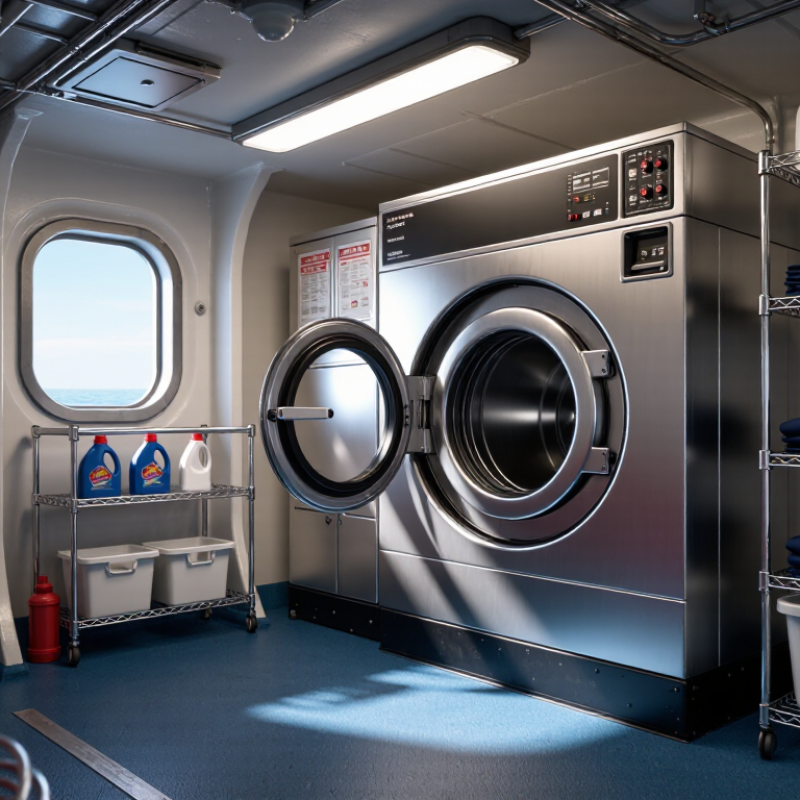
Define Marine Washing Requirements and Onboard Laundry Conditions
Before choosing a marine washing machine, define the real laundry workload. Count crew members, cabin occupancy, and weekly washing cycles. A small boat may need only a compact unit. A working vessel may require daily operation. Separate towels, uniforms, bedding, and heavily soiled workwear. Their different loads affect capacity, cycle time, and water use.
Inspect the onboard conditions carefully. Measure the installation space, door clearance, and route for delivery. Check the available voltage, frequency, and circuit capacity. Confirm fresh-water pressure and drainage height. Low pressure can reduce cleaning performance. Poor drainage can leave water under the machine. Vibration matters too. A flexible floor may create noise, movement, or premature wear. Use secure mounting points where appropriate.
Salt air changes the decision. Choose corrosion-resistant construction and protect exposed connections. Review humidity, ventilation, and ambient temperature near the laundry area. Heat and dampness can damage controls over time. In practice, operators often underestimate drying needs. A washer may finish its cycle, but wet clothing still requires airflow and space. That assumption often fails. Leave room for filter cleaning and hose inspection. Record the heaviest normal load, not an unusual peak. Overloading saves minutes today and may shorten service life. Also consider who will operate the machine. Clear controls and repeatable programs reduce mistakes during busy watch schedules. A written load guide can help, although crews may not follow it perfectly. Their feedback should influence the final choice.
Compare Capacity, Dimensions, and Available Installation Space
7 Tips for Choosing a Marine Washing Machine?
Tip 1: Measure the installation space before comparing machines. Record height, width, and depth, including hoses and electrical connections. A narrow cabinet may still need extra rear clearance. Tip 2: Check doorway and hatch dimensions. The machine must reach its final position without forced tilting or risky handling. Tip 3: Leave room for the door to open fully. This matters in tight laundry compartments.
Tip 4: Match capacity with the vessel’s real laundry habits. A two-person crew may need a smaller drum, while frequent offshore operations require more capacity. Larger drums are useful, but they demand more water, power, and floor strength. Tip 5: Check the loaded weight, not only the empty dimensions. Movement at sea can expose weak supports. I once underestimated service clearance; the machine worked, but maintenance became awkward. That mistake is worth avoiding.
Tip 6: Inspect ventilation around the unit. Warm, damp air needs a clear path away from cabinets and wiring. Tip 7: Confirm hose reach, drainage height, and access to filters. A compact installation can become frustrating when basic cleaning requires dismantling panels. Choose a layout that allows a technician to reach connections comfortably. Small gaps matter. Measurements should be written down, then checked again before purchase.
7 Tips for Choosing a Marine Washing Machine: Capacity, Dimensions, and Installation Space
Compare typical compact and full-size washing machine formats before selecting a unit for a marine installation. Allow extra clearance for ventilation, hoses, vibration, and door movement.
Practical guidance: choose capacity according to crew size and laundry frequency, measure the available opening rather than only the room, and confirm that the finished width, depth, height, electrical supply, drainage, and ventilation match the installation area. The dimensions shown are representative ranges for common compact and residential washer formats; always verify the final product specification.
Evaluate Marine-Grade Materials and Corrosion Resistance
A marine washing machine faces salt spray, humidity, vibration, and limited ventilation. Material selection matters more than attractive panels. During vessel inspections, check stainless-steel drums, fasteners, hinges, and hose fittings closely. The weakest component often fails first.
The AMPP IMPACT study estimated global corrosion costs at about US$2.5 trillion annually, equal to roughly 3.4% of global economic output. It also reported that 15–35% of corrosion costs could be avoided through better prevention. For marine equipment, this supports choosing corrosion-resistant alloys and sealed electrical connections. Grade 316 stainless steel offers stronger chloride resistance than common 304 steel because of its molybdenum content. It is not corrosion-proof. Crevices, detergent residue, and stagnant seawater can still produce pitting.
Ask for documented material specifications, not vague terms such as “marine quality.” ISO 12944 can help assess protective coating systems, although it does not replace appliance-specific testing. Salt-spray results under ASTM B117 are useful for comparison, but they do not perfectly predict years of onboard service. That detail is easy to miss.
Inspect the drain area. Look for smooth welds, accessible filters, and no exposed carbon-steel screws. A 2023 maritime safety report from the International Maritime Organization emphasizes maintenance and equipment reliability as practical risk controls. In real use, rinsing salt deposits with fresh water and keeping the door seal dry may extend component life. I would still question any model promising zero corrosion. That promise sounds convenient, not technical.
Check Energy, Water, Ventilation, and Drainage Requirements
Choosing a Marine Washing Machine: 7 Practical Tips
Choosing a marine washing machine requires more than checking drum size. Onboard power can fluctuate, and high startup demand may trip protection systems. Check voltage, frequency, running watts, and peak load against the vessel’s electrical supply. Leave a safety margin. I once underestimated this margin, and repeated restarts wasted time during a rough crossing. The lesson was simple: capacity on paper is not always capacity at sea.
Tip 1: Measure water use per cycle. Freshwater tanks are limited, so efficient rinse programs matter. Confirm inlet pressure and hose fittings before installation. Salt air can damage exposed connections. Use corrosion-resistant hardware and inspect seals regularly. Water economy sounds minor until laundry competes with cooking, cleaning, and drinking. Do not trust marketing claims alone. Compare tested cycle data from reliable technical documents.
Tip 2: Plan ventilation and drainage together. A damp locker can create odors, mold, and corrosion. Provide airflow around the cabinet while protecting the machine from spray. The drain hose needs a secure route, correct height, and dependable trap or approved discharge arrangement. Poor drainage can cause backflow when the vessel heels. Tip 3: Allow service access. Filters, pumps, and hoses need inspection space. I prefer a dry test under load before final fastening. It reveals small mistakes, though not every mistake.