
How Can We Help You?

How to Choose the Best Granulation Machine?

Choosing the best Granulation Machine requires more than comparing motor power, chamber volume, or purchase price. It requires matching equipment behavior with powder behavior. Flowability, moisture sensitivity, particle-size targets, batch scale, and cleaning requirements can change the decision completely.

Industry data supports careful evaluation. Grand View Research reports continued growth in pharmaceutical granulation equipment, driven by stricter quality controls and expanding solid-dose manufacturing. The FDA’s Process Validation guidance also emphasizes that critical process parameters must remain linked to measurable product quality. In practice, this means checking torque, impeller speed, endpoint signals, temperature, and granule moisture during trials. A machine that produces uniform granules in a laboratory may behave differently at commercial scale. Scale-up is rarely perfect.

Wolfgang Pietsch, a widely cited authority on agglomeration technology, wrote, “Agglomeration is a size-enlargement process.” This simple statement remains useful. Granulation is not only about making larger particles. It can improve flow, reduce dust, support tablet compression, and control segregation. However, a stronger-looking granule is not always a better granule. Excessive shear may create dense particles that dissolve too slowly. Insufficient wetting may leave weak, dusty agglomerates.

The right choice should therefore consider process evidence, not attractive specifications. Request application trials. Examine the granules by sieve analysis, bulk density, friability, and moisture testing. Review cleaning access and data-recording functions. A cheaper machine may become expensive when validation, downtime, and product losses appear later. Some assumptions will need revision. That is part of responsible equipment selection.
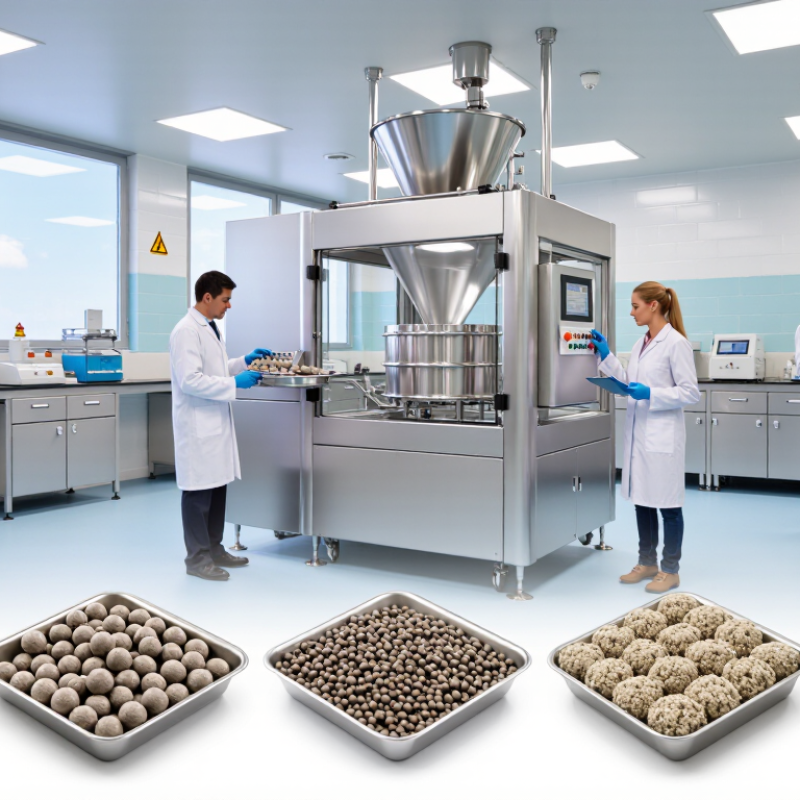
How to Choose the Best Granulation Machine?

What Is a Granulation Machine and How Does It Work?

A granulation machine converts fine powders into larger, more manageable granules.

This matters when powder dusts easily, flows poorly, or separates during handling. In practical use, granules can improve feeding accuracy, storage, and consistent processing. The machine does not simply compress everything. Its performance depends on moisture, particle size, formulation, and pressure.

In wet granulation, a controlled liquid binder is sprayed onto blended powder.

An impeller or high-speed mixer distributes the liquid while particles collide and join. The wet mass then passes through a screen or rotor. This creates moist, uneven pieces that require drying and sizing.

Dry granulation uses compaction rollers or a slugging press instead.

Pressure forms ribbons or compacted sheets, which are milled into granules. It avoids added liquid, but excessive force may produce dense, slow-dissolving particles.

Choosing a suitable machine starts with the material, not the machine name.

Check flow behavior, moisture sensitivity, heat tolerance, target granule size, and required output. For example, a heat-sensitive powder may need gentle, low-temperature processing. A sticky formulation may demand careful screen selection and cleaning access.

Operators should inspect granule shape, dust level, and size distribution during trials. Small adjustments to binder rate or screen speed can change the result.

I would not trust a single successful batch. Repeatability, maintenance time, and safe operation reveal the machine’s real value.

Which Granulation Process Best Fits Your Material?

How to Choose the Best Granulation Machine?

The right machine depends on material behavior, not only production volume. Start with moisture sensitivity, compressibility, particle size, and heat tolerance. For poorly flowing powders, wet granulation can improve density and tablet strength. However, it adds drying time and possible degradation. The FDA Process Validation guidance recommends linking critical material attributes with measurable process parameters.

Dry granulation suits moisture-sensitive or heat-sensitive powders. Roller compaction can produce ribbons, but excessive pressure may create hard-to-break granules. A practical starting range is 250–1,000 micrometers, reported frequently in peer-reviewed powder-processing studies. Smaller particles may improve mixing, yet they can increase dust and reduce flow. That trade-off is easy to underestimate.

For thermoplastic or waxy materials, melt granulation may reduce liquid handling. Fluid-bed granulation offers efficient drying and coating in one vessel, but airflow must match particle density. The European Pharmacopoeia and ICH Q8(R2) both support controlling attributes such as particle-size distribution, moisture, and bulk density. Do not choose from a brochure alone. Test your actual powder. I once saw a formulation fail because laboratory granules flowed well, while production-scale granules formed weak bridges. Scale changes everything. A small pilot trial remains cheaper than correcting a full-scale batch.

How to Compare Granulator Types and Key Features?

Choosing a granulation machine starts with the material, not the machine name. Compare how each type handles moisture, heat, particle size, and production volume. High-shear granulators mix powders quickly and create dense, uniform granules. They suit formulations needing strong agglomeration. However, their intense mixing can raise product temperature.

Wet granulators offer excellent control when a liquid binder improves flow or compressibility. Check spray distribution, mixing time, and drying requirements. Roller compactors use pressure instead of liquid, making them useful for moisture-sensitive powders. They usually simplify drying, but may create more fines or harder granules. Oscillating and screening granulators can provide gentler size reduction after drying. Their performance depends heavily on screen design and feed consistency.

Key features deserve a practical comparison. Adjustable speed, torque monitoring, and accurate liquid dosing improve process control. A removable product-contact area makes cleaning faster and reduces hidden residue. Inspect sealing, dust control, noise, access for maintenance, and the availability of replacement screens or blades. Do not judge capacity from a brochure alone. Run a representative trial using your actual powder, target moisture, and desired particle range. Measure yield, fines, temperature, energy use, and cleaning time.

A smaller machine may be wiser. Oversizing can reduce mixing quality and waste energy. Yet, laboratory results may not scale perfectly because airflow, heat transfer, and residence time change. Leave room for uncertainty, and document every setting. The best choice is the type that delivers repeatable granules without creating avoidable maintenance or process problems.

What Production, Quality, and Safety Factors Should You Assess?

How to Choose the Best Granulation Machine?

A suitable granulation machine should match the required output, material behavior, and production schedule. During plant trials, operators should measure hourly capacity instead of trusting brochure estimates. Feed moisture, particle shape, and bulk density can change performance significantly. A machine that handles one material well may struggle with another. Check feeding stability, screen changes, motor load, and cleaning time. These details affect labor costs and unplanned downtime.

Quality depends on more than uniform-looking granules. Inspect size distribution, moisture content, density, and surface condition after each trial. A practical test uses several samples from different production points. This can reveal segregation or inconsistent feeding. Ask whether the machine maintains stable results during long runs. Short tests can hide heat buildup and gradual wear. I have seen acceptable samples become weaker after continuous operation. That possibility deserves attention.

Safety assessments should cover guards, emergency stops, electrical protection, noise, dust control, and access for maintenance. Fine particles can collect around drives, filters, and transfer points. Cleaning procedures must reduce exposure and prevent material buildup. Operators need clear training, inspection records, and realistic protective equipment requirements. Do not overlook awkward lifting positions or slippery floors. A polished demonstration does not prove safe daily operation. Request a supervised trial with actual material, normal staff, and routine cleaning conditions. The machine should fit the workplace, not force workers to improvise.

How to Choose the Best Granulation Machine?

Compare typical granulation technology profiles across production, quality, energy, containment, and safety factors. Scores are normalized to a 100-point assessment scale and should be validated against your material, batch size, and regulatory requirements.

High-shear batch systems generally provide strong mixing and granule uniformity, continuous systems can support higher throughput, and low-shear systems are often preferred for heat-sensitive or fragile materials. A final selection should also include validation trials, cleaning requirements, dust-control testing, and machine safety compliance.

How to Select, Operate, and Maintain the Right Granulator?

Choosing a granulator starts with the material, not the machine’s appearance. Identify hardness, moisture, temperature, and the required particle size. A soft polymer needs different cutting conditions than a brittle compound. Record the expected hourly throughput, because overloaded equipment creates heat, vibration, and uneven granules. Ask for a controlled material trial before purchasing. Small samples can reveal feeding problems that specifications may hide.

Operation should begin with an empty chamber and a stable feed rate. Never force large lumps through a narrow inlet. Watch motor current, vibration, temperature, and granule shape during production. Unusual noise often appears before serious damage. Operators should use guards, emergency stops, and approved protective equipment. Clear instructions matter, but practical training matters more. A confident operator may still make a poor adjustment.

Maintenance requires a written schedule and careful records. Inspect blades, screens, bearings, belts, and fasteners at planned intervals. Clean the chamber after compatible production runs, especially when residue can harden. Replace dull blades instead of increasing motor power. That shortcut usually wastes energy. Isolate power before opening the cutting chamber, and verify zero movement. No choice is perfect. A trial may expose an overlooked weakness, which is useful. Recheck the machine after several weeks, because real production rarely matches the first test.