How to Choose a Portable Water Air Cooler?
Choosing a Portable Water Air Cooler looks simple until room size, humidity, noise, and maintenance become important. A compact unit may feel powerful beside a desk, yet disappoint in a large, sealed room. The right choice depends on real conditions, not only attractive specifications.
Dr. William P. Bahnfleth, an HVAC researcher and indoor-environment specialist, is often associated with this practical principle: “Good cooling begins with understanding the space, not merely buying the biggest unit.” That idea should guide every Portable Water Air Cooler decision. Measure the room first. Check the airflow direction. Notice whether windows remain open. Evaporative cooling performs best where fresh air can circulate, while humid climates may reduce its cooling effect.
Look beyond the advertised water-tank capacity. A larger tank can extend operation, but it may also increase weight and cleaning effort. Examine the cooling area, fan-speed settings, power consumption, noise rating, filter access, and automatic shutoff features. A visible water-level indicator helps during nighttime use. A removable tank makes weekly cleaning less troublesome.
Small details matter.
For example, wheels can help on tile but struggle on thick carpet. A remote control feels convenient, though it can fail or disappear. No model is perfect. Some buyers focus too heavily on cooling output and overlook stale water, mineral buildup, or uncomfortable humidity. This guide will compare practical features, common mistakes, and room-specific needs, helping readers choose with evidence rather than impulse.
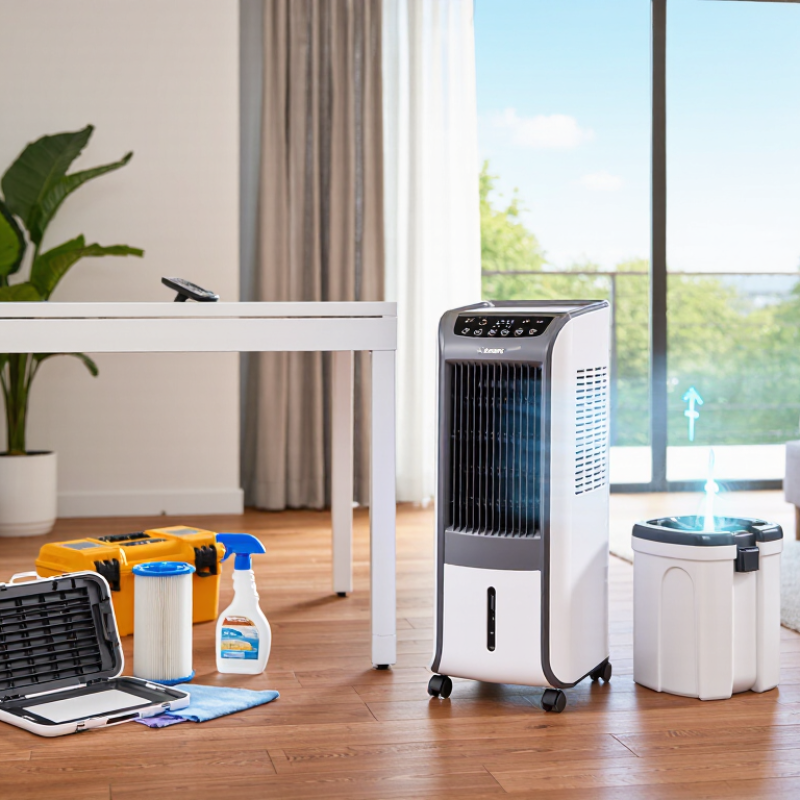
Understanding How Portable Water Air Coolers Work
A portable water air cooler works through evaporative cooling, not refrigeration. A fan pulls warm room air across wet cooling pads. As water changes into vapor, it absorbs heat from the passing air. The outlet air feels cooler, but it also contains more moisture.
This process works best in hot, dry rooms. In humid conditions, evaporation slows, and the cooling effect becomes weaker. The U.S. Department of Energy reports that evaporative cooling can use about one-quarter of the energy consumed by comparable central air conditioning. However, that figure does not guarantee equal comfort from every portable unit. The International Energy Agency’s The Future of Cooling report notes that space cooling could become one of the fastest-growing sources of electricity demand. Efficiency matters, but operating conditions matter too.
Tips: Check the room’s humidity before choosing a cooler. Keep a window slightly open, because fresh airflow helps remove added moisture. Use clean water and wash the tank regularly. The pads should not smell damp. For a small bedroom, place the unit near an open window and direct airflow toward the occupied area. I have found that placing it beside a heat source reduces comfort, despite strong airflow. That was a useful reminder: airflow is not the same as cooling. Also, portable coolers need refilling, and their water use can be easy to underestimate. Evidence from ASHRAE comfort guidance suggests that temperature alone does not define comfort; humidity, air movement, and personal sensitivity also influence the result.
Identifying the Right Cooling Capacity and Coverage Area
How to Choose a Portable Water Air Cooler?
Cooling capacity should match the space, not only the product label. Measure the room’s length and width, then consider ceiling height. A cooler rated for 300 square feet may perform poorly in a tall, open room. Airflow matters too. Look for the unit’s airflow rating, usually listed in cubic feet per minute. Larger rooms need stronger circulation.
A water air cooler works best in dry, well-ventilated conditions. It adds moisture while moving air across a wet cooling pad. In humid weather, the cooling effect can become weak and uncomfortable. Open windows or doors slightly to release damp air. For a small bedroom, place the unit near an open window and aim the airflow toward the occupied area. For a workshop, choose wider coverage and stronger airflow.
I once selected a cooler by floor area alone. That judgment was incomplete. Direct sunlight, poor insulation, and several people raised the room temperature quickly. A shaded room needed less power than expected. Check the actual space during its hottest period, if possible. Start with the manufacturer’s stated coverage, then choose extra capacity when the room has high ceilings or frequent heat sources. Oversizing is not always better, however. It can increase water use, noise, and energy consumption without improving comfort.
How to Choose a Portable Water Air Cooler?
Identifying the right cooling capacity and coverage area
Airflow is the main sizing reference for a portable water air cooler. The estimates below compare typical airflow classes with a practical coverage area for a room with approximately 2.5 m ceilings. Actual performance depends on humidity, ventilation, sunlight, insulation, and whether doors or windows are open.
For effective cooling, choose a model whose recommended coverage area is at least 20% larger than the room you want to cool.
Comparing Water Tanks, Power Use, and Portability
A portable water air cooler should match your room, routine, and tolerance for refilling. Tank size matters more than many product descriptions suggest. A compact tank may last only a few hours on high airflow. A larger tank extends operation, but it adds weight and makes the unit less convenient to carry.
Check the rated power draw in watts, not only the advertised cooling effect. For example, a 60-watt cooler running for five hours uses about 300 watt-hours. Actual use may vary with fan speed, pump activity, and room temperature. A lower setting saves power, but it may provide weaker airflow. I once chose a very efficient model that felt disappointing during a hot afternoon. Efficiency alone was not enough.
Portability depends on more than a handle. Look for a balanced shape, secure tank access, and controls that do not activate during transport. A full tank can make a small cooler surprisingly heavy. Wheels help on smooth floors, but they are less useful on stairs or uneven surfaces. Measure the storage space before buying. Also consider humidity. Evaporative cooling works better in dry air and may feel limited in damp rooms. Manufacturers should state tank capacity, power input, airflow settings, and expected runtime clearly. If those figures seem incomplete, compare independent measurements and treat optimistic runtime claims carefully.
Checking Airflow Settings, Controls, and Useful Features
Choosing a portable water air cooler requires more than checking its size or water tank capacity. Airflow settings often determine daily comfort. Look for at least three speeds, such as low, medium, and high. A wide outlet can move air across a small room, while adjustable louvers direct cooling toward a chair or bed. Swinging airflow helps prevent one cold spot. Test the lowest setting at night. A powerful fan can become distracting.
Controls should feel simple when the room is dark. Clearly marked buttons, a remote control, and a readable display are useful features. A timer can reduce overnight running time, while a water-level indicator prevents unexpected stops. Some models include an oscillation function and a cooling mode that wets an internal pad. These settings may improve comfort in dry air, but they cannot replace an air conditioner in humid weather.
“ I once focused too much on maximum airflow. It sounded impressive, but the noise made conversation difficult. My better choice was a quieter model with moderate circulation. Check the sound rating if available, although published figures may not reflect every room. A washable filter, removable tank, and drain plug also matter. They make routine cleaning easier and help reduce stale odors. Do not ignore the power cord length. A cooler with excellent controls is less useful when it must sit awkwardly beside an outlet. Test the buttons, airflow direction, and tank access before judging the machine.
Evaluating Maintenance Needs, Safety, and Overall Value
How to Choose a Portable Water Air Cooler?
A portable water air cooler should be judged by maintenance, safety, and value. The U.S. Department of Energy reports that evaporative coolers can use about one-quarter the energy of central air conditioning. That advantage depends on a dry climate and proper airflow. In humid rooms, cooling performance may disappoint. Check the water tank opening before buying. A narrow opening can make scrubbing difficult, especially when mineral residue collects around the pump.
Maintenance is not optional. The U.S. Environmental Protection Agency advises regular cleaning for devices that hold water, because stagnant water can support microbial growth. Choose a removable tank, washable filters, and accessible cooling pads. A weekly rinse is realistic for frequent summer use. Deeper cleaning may be needed every few weeks. Follow the manual’s instructions, even when they seem excessive. I would also inspect the power cord near wet floors. Small leaks create large worries.
Safety affects overall value. Use a grounded outlet and keep the unit away from standing water. The U.S. Consumer Product Safety Commission repeatedly emphasizes keeping electrical products and cords away from water. Select models with automatic shutoff when the tank empties. That feature protects the pump and reduces careless operation. Noise matters, too. A cooler rated at 50 decibels may feel intrusive beside a bed. Energy savings look attractive, but replacement pads, cleaning time, and water use deserve calculation. A cheaper unit can become expensive through neglect.