
Choosing Drying Oven Manufacturers in 2026 takes more than comparing prices or catalog specifications. The right supplier should understand what your process actually requires, from the material being dried to the load size and daily operating schedule. Ask how the oven maintains temperature across its chamber, how airflow is managed, and what records its controls can provide. Small details matter. A crowded tray, a slow door seal, or uneven airflow can affect results over time.
A careful assessment also looks beyond the equipment. Review the manufacturer’s technical documentation, installation guidance, warranty terms, spare-parts availability, and service response process. Request evidence that proposed performance matches your operating conditions, such as test results or a demonstration using a representative load. Confirm that the stated temperature range, uniformity, and control features suit your application rather than relying on broad marketing claims. Requirements can vary by industry and location, so verify applicable standards with qualified specialists. No checklist catches everything. A polished quotation can still leave service details vague, and a factory visit may not reveal long-term support quality. It is worth admitting that choosing a supplier involves some uncertainty. This guide offers practical questions and comparison points to help you assess Drying Oven Manufacturers with clearer expectations and make a decision grounded in evidence, not promises.
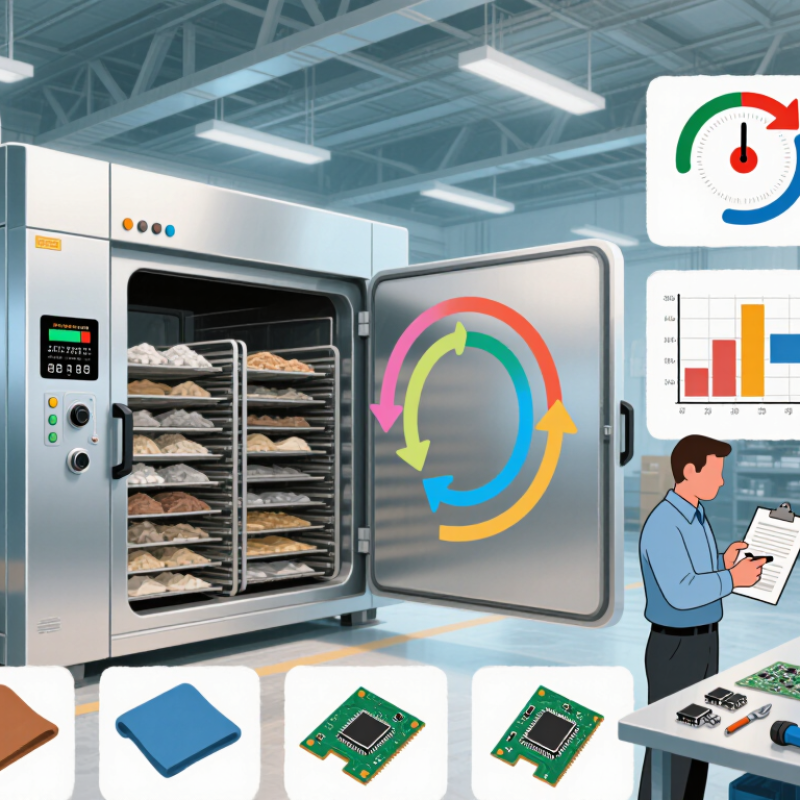
ASTM E145 distinguishes Type I gravity-convection ovens from Type II forced-ventilation ovens. That distinction affects more than heating speed. A gravity oven moves air naturally, which may suit gentle drying or samples easily disturbed by airflow. A forced-air unit circulates heat actively, often helping loaded shelves recover temperature faster. Check the current ASTM E145 specification and request test records; a catalogue label alone does not prove performance.
Define the working range from the actual material and method. For example, drying glassware near 105°C differs from conditioning a heat-sensitive polymer at a lower setpoint. Record the minimum and maximum operating temperatures, routine setpoint, load size, and acceptable uniformity. Ask manufacturers for temperature-mapping results with a representative load, not just an empty-chamber reading. Small details matter. Shelf position can change results.
Also check recovery after door openings and temperature stability across the usable chamber. ASTM E145 provides a common technical basis for oven classification and evaluation, but it cannot decide whether airflow suits your samples. A common buying mistake is specifying the highest possible temperature first. I would challenge that habit: an oversized range can add cost without improving the process. One awkward point remains: real loads vary, so repeatability should be confirmed during commissioning.
| Selection dimension | Process need or planning example | What to evaluate with the manufacturer | Evidence to request |
|---|---|---|---|
| ASTM E145 oven type | Type I uses gravity convection; Type II uses mechanical (forced) convection. | Choose the airflow approach that fits the load, drying method, and uniformity requirements. Forced airflow may suit processes that benefit from circulated air; assess whether airflow could disturb lightweight or delicate samples. | Written confirmation of the oven type and the applicable ASTM E145 edition used for the stated compliance claim. |
| Required operating range | Define the lowest and highest process setpoints. For example, a process operating between 60°C and 120°C needs a usable range that covers both setpoints with suitable control margin. | Compare the stated operating range with the process range, room conditions, load, and any required recovery after door opening. Do not select from maximum temperature alone. | Published operating range, control limits, and any restrictions associated with load size or ambient conditions. |
| Temperature uniformity | Important when samples across the usable chamber must experience comparable temperatures. | Specify the usable chamber volume and the uniformity requirement at the actual working temperature and load. Clarify how the manufacturer defines and measures uniformity. | Temperature-distribution test method, test conditions, sensor locations, and a sample or model-specific test report. |
| Temperature stability and control | Relevant when a process must remain near a setpoint for a defined hold time. | Assess controller capability, display resolution, alarm functions, and stability under representative operating conditions. Display resolution alone does not establish temperature accuracy. | Controller specifications, calibration information, alarm details, and documented performance at the required setpoint. |
| Chamber capacity and loading | Plan around sample dimensions, batch size, shelf spacing, and clearance for airflow. | Check internal dimensions, usable shelf area, shelf load limits, and whether the proposed load arrangement leaves adequate air circulation. | Dimensioned chamber drawing, shelf configuration, and maximum load information. |
| Air exchange and exhaust | Moisture removal and ventilation needs depend on the material and process; some applications may require an exhaust connection. | Ask how fresh-air intake, exhaust, and dampers are configured. Confirm facility ventilation requirements and whether the process material is suitable for the oven. | Airflow or ventilation details, exhaust connection requirements, and operating instructions. |
| Materials and safety | Consider sample compatibility, cleaning needs, and risks from flammable, corrosive, or hazardous vapors. | Review chamber and shelf materials, electrical protection, over-temperature protection, and intended-use limitations. A standard laboratory drying oven is not automatically suitable for hazardous atmospheres. | Construction specifications, safety features, installation guidance, and documented exclusions for use. |
| Calibration and service | Useful where records, repeatability, or routine verification are part of laboratory quality procedures. | Check calibration access, recommended verification practices, service availability, spare-parts support, and documentation options. | Calibration or verification documentation options, service schedule, warranty terms, and parts-support information. |
| Manufacturer comparison | Compare equivalent configurations rather than headline specifications alone. | Use the same oven type, usable capacity, operating range, loading conditions, and required performance criteria when reviewing proposals. | A model-specific quotation and a completed specification checklist addressing each process requirement. |
| Important: ASTM E145 identifies laboratory oven types and establishes specification requirements; the example temperatures above are process-planning examples, not ASTM E145 temperature classes or guaranteed performance limits. Confirm the applicable standard edition, test conditions, and model-specific claims directly from the manufacturer. | |||