
How Can We Help You?

China Best Closed Die Hot Forging Machining Supplier?

Choosing the right closed-die hot forging supplier involves more than comparing prices or reviewing polished product photos. Forging temperature, die design, material traceability, and machining control all affect the finished component. A small mismatch can appear later as uneven dimensions, surface defects, or costly assembly delays. Details matter.

A reliable supplier should explain how billets are heated, how dies are maintained, and how parts are inspected after forging. Ask for material certificates, process records, and sample inspection reports. For critical dimensions, confirm the measurement method and tolerance before production begins. Heat treatment and final machining also deserve careful review, since both can change a part’s dimensions and performance. A capable partner will discuss these risks plainly, rather than promise perfect results without evidence.

The phrase “Machining Hot Mold Closed” may appear in supplier searches, but clear technical communication matters more than any label. Look for practical experience with your material, part geometry, and production volume. Review samples for consistent flash trimming, clean machined surfaces, and repeatable measurements. Then compare lead times, tooling costs, and quality controls against your actual requirements. No supplier is right for every job. Even a well-managed process can need adjustment after first-article inspection. That is worth acknowledging. A thoughtful sourcing decision starts with precise drawings, direct questions, and evidence that the supplier can control each step from heated billet to finished part.
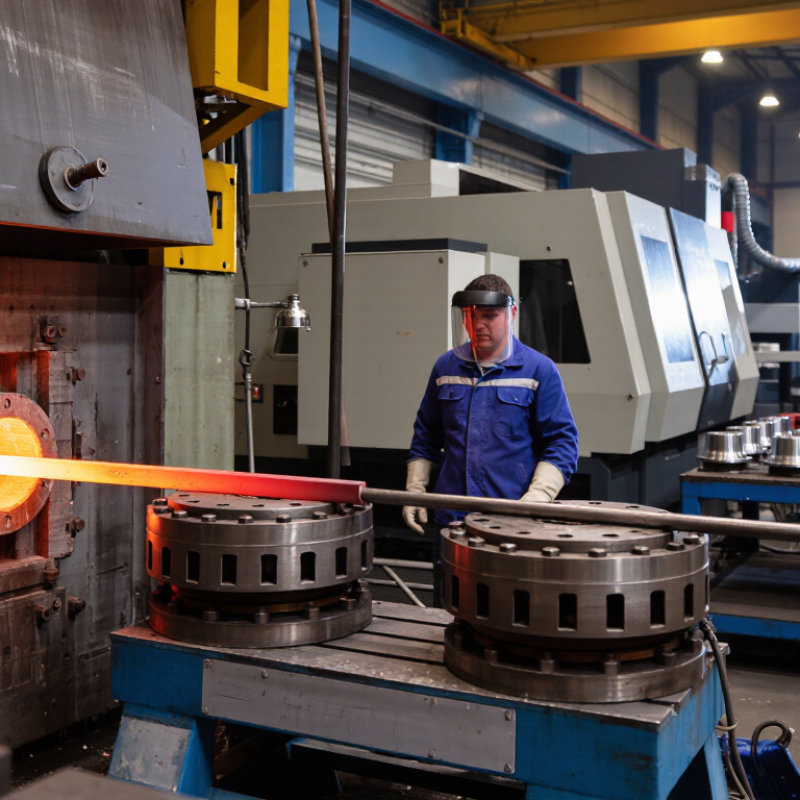
China Best Closed Die Hot Forging Machining Supplier?

What Is Closed-Die Hot Forging and How Does Machining Fit?

Closed-die hot forging presses heated metal between matched dies, forcing it into a shaped cavity. The heat lowers the metal’s resistance to deformation, while the dies control the part’s geometry. Steel is commonly forged above its recrystallization range; exact temperatures depend on alloy and process. The World Steel Association reported 1,888.2 million tonnes of crude steel production in 2023, illustrating the scale of the material supply behind many forged components. That figure is not a measure of forging output, but it gives useful industrial context. Die design still matters more than volume alone.

Machining usually follows forging, not replaces it. It removes scale and excess material, then creates precise bores, threads, sealing faces, and bearing seats. A forged blank may arrive with flash, draft angles, and dimensional variation, so machinists need realistic stock allowances and stable locating surfaces. Keep critical datums accessible. That matters. Too little stock can leave oxide or die mismatch on a finished face; too much adds cycle time and tool wear. ASM Handbook, Volume 14A, details forging and downstream considerations, but each alloy, geometry, and production route needs its own process review. In practice, the forging-to-machining handoff is rarely perfect; test cuts and measurement feedback help refine it.

How Are Chinese Hot Forging Suppliers Evaluated?

China Best Closed Die Hot Forging Machining Supplier?

How Are Chinese Hot Forging Suppliers Evaluated?

A capable supplier should show how it controls each step, from billet heating to finished machining. Ask for material certificates, furnace records, die-maintenance logs, and inspection results. World Steel Association reported global crude steel production of 1,882.6 million tonnes in 2024. That scale makes consistent material traceability important, but it does not prove any individual supplier’s quality. Ask to review records for the actual alloy and part you need.

Check dimensional capability using sample parts, not promises alone. Review critical tolerances, measurement methods, defect trends, and corrective-action records. Ask how the supplier controls billet temperature, press parameters, and die wear across production runs. Numbers need context. A low defect rate is less convincing without its measurement period, sample size, and defect definition. Where possible, compare trial parts with drawings and agree on acceptance criteria before production.

Machining and heat treatment also deserve scrutiny. Confirm whether these steps happen in-house or through qualified partners, and request traceable inspection records either way. The IEA notes that steel production accounts for about 7% of global CO2 emissions; energy use and scrap handling can therefore inform a supplier’s environmental review. They do not replace technical audits. A site visit may reveal practical details, such as uneven furnace loading or unclear gauge calibration. I would not treat one visit as conclusive; repeat checks and independent measurements offer stronger evidence.

Which Capabilities Matter When Selecting a Supplier?

Which Capabilities Matter When Selecting a Supplier?

A capable closed-die hot forging supplier controls the process from billet heating through final machining. Ask how it monitors furnace temperature, die wear, press capacity, and material batches. These details affect grain flow, flash formation, and dimensional consistency. Request sample inspection records, not just a capability list.

Look closely.

Machining matters as much as forging. Confirm the supplier can hold the drawing’s critical tolerances, inspect features with calibrated equipment, and report results in a clear format. For repeat orders, ask how process changes and nonconforming parts are documented. A polished audit file helps, but it cannot replace stable production evidence.

That distinction is easy to miss.

Digital traceability can strengthen that evidence. Deloitte and MAPI’s 2019 Smart Factory Study found that 86% of surveyed manufacturers expected smart factory initiatives to drive competitiveness within five years. The figure is not specific to forging, but it highlights the value of connected production data. Ask whether heat-treatment records, inspection results, and batch identifiers can be linked to each shipment. Also review tooling maintenance plans and corrective-action examples. A supplier may meet the specification once, yet struggle to repeat it across lots.

Verify the process, not only the sample.

How Can Quality Systems and Certifications Be Verified?

For a closed-die hot forging supplier, a certificate is a starting point, not proof of consistent production. Check the certificate number, issuing body, validity dates, factory address, and stated scope. Confirm its status through the issuer or a recognized accreditation directory. The scope should match the actual site and activities, not just general manufacturing.

Paper is not proof. Ask to review recent audit findings and corrective-action records, with confidential details removed if necessary. Then compare them with production evidence: furnace temperature charts, material heat-lot traceability, hardness results, and dimensional inspection reports. Check whether gauges and testing equipment have current calibration records. A capable quality team should explain how it handles a missed tolerance, from isolating affected parts to documenting reinspection. Ask to see a sample record for a real production lot. Details matter.

A polished presentation can hide gaps. I would also ask how operators record process changes between shifts, since handwritten entries may be incomplete. That is not an automatic rejection, but it deserves a clear answer and supporting records. Match each claim to evidence from the specific plant producing your parts.

What Factors Determine the Best Supplier for Your Project?

Choosing a closed-die hot forging and machining supplier in China requires more than comparing unit prices. Start with process capability: ask how the supplier controls billet temperature, die wear, flash, and machining allowance. These details affect grain flow, dimensional consistency, and scrap rates. Request sample inspection records, material certificates, and a clear plan for heat treatment and final machining. A polished sample helps, but repeatable batch results matter more.

Check the supplier’s equipment, inspection methods, and experience with your part’s geometry and alloy. The World Steel Association’s World Steel in Figures 2024 reports global crude steel production of 1,892.2 million tonnes in 2023. That scale makes material identification and batch traceability important—not automatic. Numbers matter. Review how each lot is linked to its material certificate, forging record, and inspection results. Compare lead time and total landed cost, too; the lowest quote may exclude tooling changes, rejected parts, or extra machining. Even a careful supplier can miss a detail, so agree on acceptance criteria before production.

Tips: Share a drawing with tolerances, material grade, annual volume, and critical surfaces. Ask for a process flow, sample dimensional report, and tooling-life estimate. If possible, inspect a first article before authorizing the full run. A little friction now can prevent costly surprises later.

China Best Closed Die Hot Forging Machining Supplier? - What Factors Determine the Best Supplier for Your Project?
Supplier evaluation framework for comparing closed-die hot forging and machining capabilities. Suggested weights are a customizable decision model, not industry-wide benchmarks.
Evaluation Factor Suggested Weight What to Verify Useful Evidence or Project-Specific Benchmark
Forging process capability 15% Confirm the supplier can forge the specified alloy, part geometry, production volume, and required process route. Process flow, equipment list, sample parts, and a review of draft, parting line, flash, and material-flow risks against the approved drawing.
Machining capability and integration 12% Check whether required turning, milling, drilling, tapping, or other operations can be completed in-house or under controlled subcontracting. Machining process plan, available equipment and work envelope, fixture approach, and inspection results for representative features.
Dimensional control 12% Assess the ability to meet drawing tolerances on both forged and machined features, including datum control and repeatability. Capability study or measurement data for critical-to-quality features; acceptance limits should come from the customer-approved drawing and specification.
Quality management and approvals 12% Review the quality system and confirm that required customer or industry approvals are in place and in scope. Current ISO 9001 certificate; for automotive projects, verify any required IATF 16949 status and customer-specific requirements. Certifications should be checked for validity and scope.
Material traceability and testing 10% Confirm control of material grades, heat or batch identification, incoming inspection, and required mechanical or chemical testing. Material test certificates, traceability records linking material lots to finished parts, and agreed test reports where specified.
Tooling and engineering support 10% Evaluate die design, tooling manufacture, die-life monitoring, engineering communication, and change control. Tooling plan, trial schedule, design review records, tooling maintenance approach, and ownership terms for dies and fixtures.
Production capacity and delivery reliability 10% Compare available capacity with forecast demand, production schedule, backup plans, and the supplier’s ability to manage demand changes. Capacity plan by process step, stated lead times for samples and production, recent on-time delivery data, and a documented escalation plan.
Cost and total cost of ownership 8% Compare the full commercial offer rather than unit price alone, including tooling, inspection, packaging, freight, and potential rework costs. Itemized quotation with assumptions, minimum order quantities, payment terms, tooling charges, and pricing validity period.
Process control and corrective action 6% Check how the supplier monitors process variation, handles nonconforming product, and prevents recurrence of defects. Control plan, inspection records, nonconformance workflow, and examples of documented root-cause and corrective-action reports.
Logistics, communication, and risk management 5% Assess export experience, packaging suitability, communication responsiveness, and contingency planning for supply interruptions. Packaging specification, shipment and customs plan, named project contacts, business-continuity measures, and agreed reporting cadence.
Total suggested weight 100% To score suppliers, assign a rating from 1 to 5 for each factor, where 1 = does not meet requirements and 5 = fully meets verified requirements. Weighted score = rating ÷ 5 × factor weight. Confirm all critical drawing, quality, and compliance requirements separately before award.